The llms.txt and llms-full.txt specifications represent two complementary approaches to solving the same fundamental challenge: how to provide artificial intelligence systems with accurate, authoritative website knowledge without drowning models in HTML bloat and JavaScript overhead.
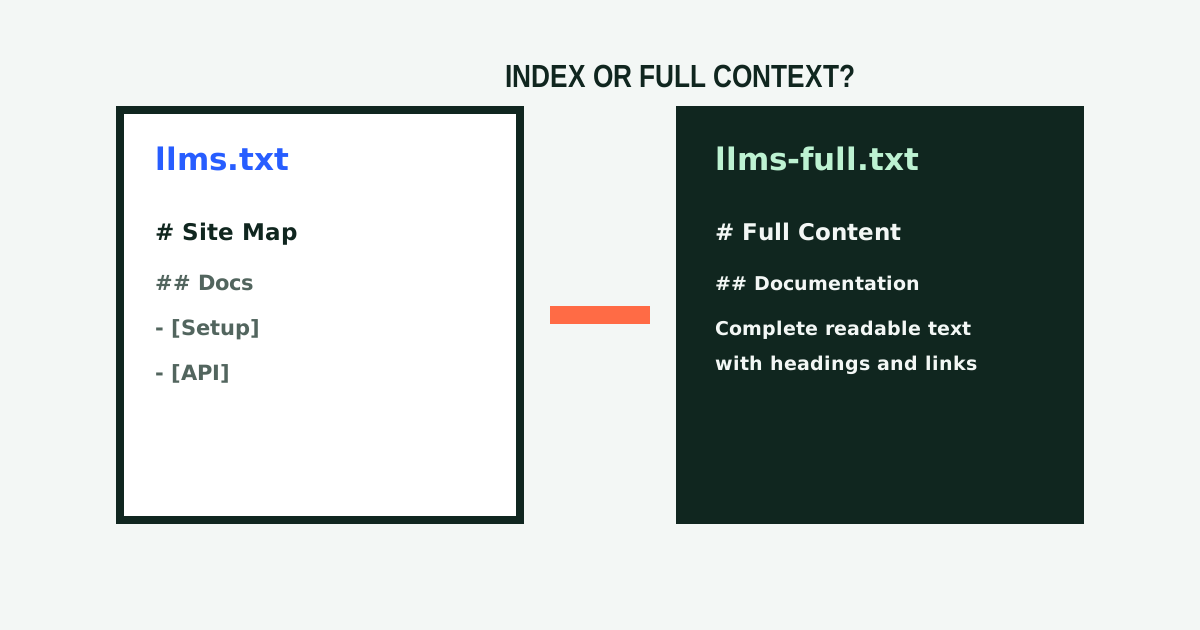
While both standards share the goal of making websites machine-readable, they serve fundamentally different operational purposes. One is an editorial table of contents designed for discovery; the other is a consolidated knowledge base designed for direct contextual ingestion.
In this architectural guide, we will analyze the technical trade-offs between both formats, explore token economics, and outline how modern engineering teams implement a dual-file architecture using our free llms.txt generator and full-text compiler.
The Core Dilemma: Navigation vs Ingestion in the AI Era
Traditional web crawlers operating on behalf of search engines (like Googlebot) crawl websites by downloading raw HTML pages, following anchor tags, and executing client-side scripts. Search engines then index these pages in vast distributed databases and return ranked blue links to human users.
Generative AI systems (such as ChatGPT Search, Perplexity, Claude, and Gemini) operate on a completely different paradigm. Instead of returning a list of links for a human to browse, they synthesize conversational answers in real time.
When an AI model attempts to answer a user’s prompt by browsing the live web, it faces two severe bottlenecks:
- Latency & Timeout Constraints: Fetching 10 to 15 separate web pages sequentially introduces 5 to 15 seconds of latency, often triggering browser timeouts or bot mitigation challenges.
- Context Window Token Saturation: Raw web pages are filled with navigation menus, stylesheet references, cookie consent banners, and tracking scripts. Feeding raw HTML into a foundation model consumes thousands of tokens on irrelevant layout markup.
The llms.txt and llms-full.txt standards solve these bottlenecks by providing structured Markdown files served directly from the root of a domain.
Deep Dive: The Design Philosophy of LLMs.txt
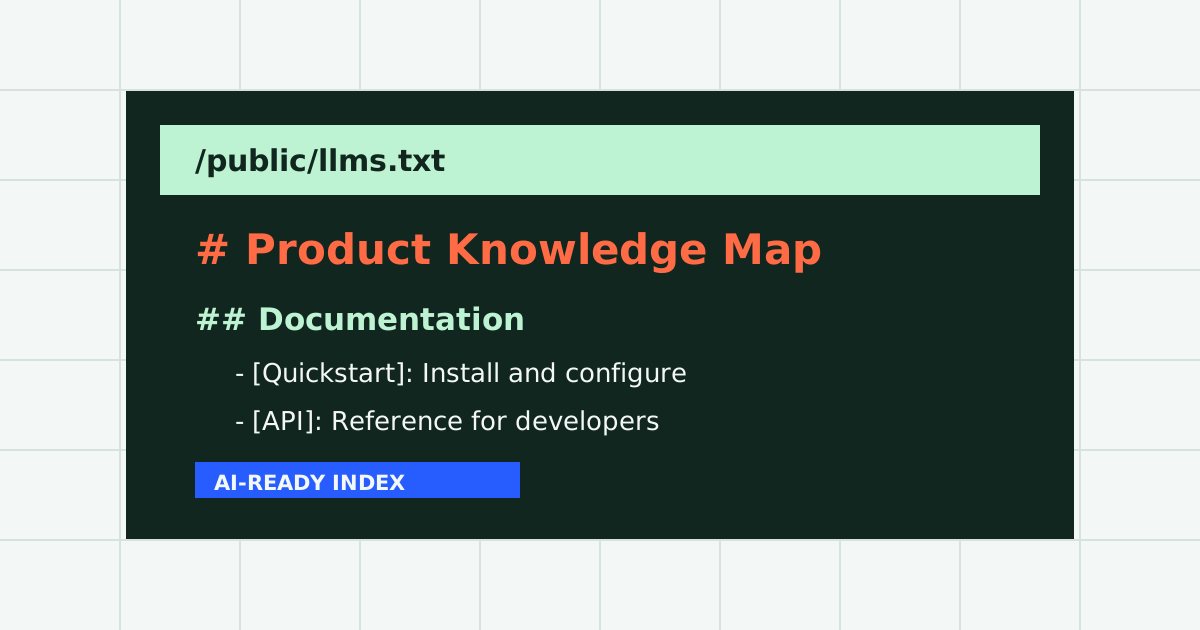
The llms.txt format, standardized at llmstxt.org, is designed as a lightweight, human-readable index. It tells language models which pages exist on a website, how they are categorized, and what specific information each page contains.
Key Characteristics of llms.txt:
- File Size: Typically 2 KB to 15 KB.
- Link Count: Curated to 20 to 80 high-signal pages.
- Syntax: Single H1, blockquote summary, categorized H2 sections, and Markdown links with one-sentence descriptions.
- Primary Function: Discovery roadmap. It directs autonomous agents to the most relevant URLs without requiring a crawl of thousands of low-value utility pages.
When to Prioritize llms.txt:
- Public AI Discoverability: Helping AI search engines (Perplexity, ChatGPT, Google AI Overviews) discover and cite your product pages, documentation, and pricing.
- Customer Support Bots: Providing automated customer service agents with a structured index of help desk articles and FAQs.
- E-Commerce Stores: Categorizing Shopify or WooCommerce catalogs into logical collections, buying guides, and shipping policies.
You can generate a compliant index file in seconds using our free llms.txt generator.
Deep Dive: The Design Philosophy of LLMs-Full.txt
While llms.txt points to pages, llms-full.txt provides the destination content itself. It compiles the full, cleaned body text of your most critical documentation, tutorials, and product guides into a single plain text file.
Key Characteristics of llms-full.txt:
- File Size: Typically 50 KB to 500 KB (depending on page count).
- Content Scope: Complete article text, code blocks, lists, and tables with layout noise removed.
- Syntax: Markdown section dividers (
---) separating distinct documents, with source URLs clearly attributed. - Primary Function: Direct ingestion. It enables an AI model to read your entire knowledge base in a single HTTP request or file upload.
When to Prioritize llms-full.txt:
- Developer Portals & APIs: Enabling AI coding assistants (like Cursor, Windsurf, or GitHub Copilot) to ingest your entire SDK reference in one prompt.
- Retrieval-Augmented Generation (RAG): Feeding private enterprise knowledge bases, Claude Projects, or Custom GPTs without setting up complex vector database pipelines.
- Zero-Latency Processing: Allowing AI models to answer complex multi-page technical questions without performing multi-hop live web crawling.
You can compile your key pages into a unified document using our free llms-full.txt generator.
Architectural Comparison: llms.txt vs llms-full.txt
| Technical Dimension | llms.txt | llms-full.txt |
|---|---|---|
| Primary Objective | Navigational index & discovery map | Complete contextual knowledge base |
| Typical File Size | 2 KB to 15 KB | 50 KB to 500 KB |
| Token Footprint | ~500 to 3,000 tokens | ~15,000 to 120,000 tokens |
| Crawler Ingestion | Instantaneous single-pass scan | Read in full or processed into chunks |
| HTTP Requests Needed | 1 request for index + follow-up requests for chosen pages | 1 single request for all knowledge |
| Best Suited For | E-commerce, SaaS landing pages, blogs, company portals | Technical documentation, developer SDKs, API references |
| Maintenance Cycle | Quarterly link review & validation | Re-generate after major product releases |
Token Economics: Calculating Context Window Costs
Understanding token consumption is critical when choosing between or combining these formats. Modern frontier models (like Claude 3.5 Sonnet, GPT-4o, and Gemini 1.5 Pro) feature massive context windows ranging from 128,000 to 2,000,000 tokens, but token efficiency remains vital for two reasons: cost and retrieval precision.
The Cost of Raw HTML vs. Clean Markdown
Consider a documentation site with 12 core tutorial pages:
- Raw HTML Extraction: Crawling 12 web pages as raw HTML yields approximately 48,000 tokens due to embedded scripts, stylesheets, SVG icons, and navigation menus. At scale across thousands of user queries, this introduces substantial API inference expenses.
- llms.txt Index: The equivalent index file consumes approximately 800 tokens. An AI agent can read the index, determine that only 2 specific pages are needed to answer the user’s question, and fetch only those 2 pages, consuming under 4,000 tokens total.
- llms-full.txt Compilation: If the AI requires unbroken knowledge across all 12 pages, the distilled Markdown consumes roughly 12,000 tokens: a 75% reduction compared to raw HTML, with zero loss of technical substance.
Attention Degradation (“Lost in the Middle”)
Research in neural language modeling indicates that foundation models suffer from attention degradation when reading noisy or bloated text streams. When an AI model processes clean Markdown formatted with semantic headings, its ability to locate specific facts and cite accurate code snippets increases dramatically compared to parsing noisy HTML dumps.
The Dual-File Architecture: How Leading Teams Implement Both
The most effective strategy is not choosing one format over the other: it is deploying both files concurrently at the root of your domain.
https://yourdomain.com/
├── robots.txt           <-- Directs crawler permissions
├── sitemap.xml          <-- Comprehensive index for search engines
├── llms.txt             <-- Fast, curated map for AI discovery agents
└── llms-full.txt        <-- Deep knowledge base for coding tools and RAG
How the Dual-File Workflow Functions:
- Public AI Search Engines (Perplexity, ChatGPT Search) query
https://yourdomain.com/llms.txt. They read your site summary and link descriptions to quickly understand your offerings and synthesize immediate citations. - AI Developers & Power Users download or link to
https://yourdomain.com/llms-full.txt. They feed this single file into Claude Projects, NotebookLM, or custom agentic workflows to analyze your complete technical documentation offline. - Automated Validation: Before pushing documentation updates to production, you run your index file through our free llms.txt validator to confirm syntax compliance and ensure that all internal URLs resolve to live 200 OK status codes.
Step-by-Step Implementation Roadmap
If you are ready to prepare your website for the next generation of AI search and retrieval systems, follow this straightforward roadmap:
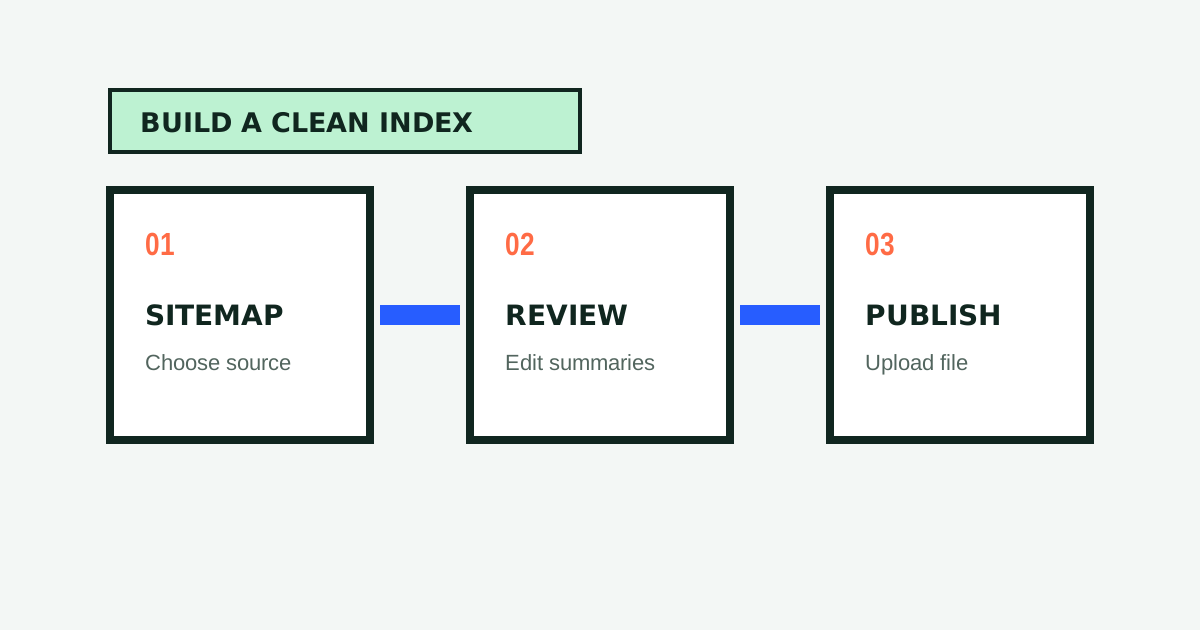
- Generate Your Index: Open our free llms.txt generator. Scan your sitemap XML or homepage to automatically create a categorized index with AI-written summaries.
- Compile Full Content: Open our free llms-full.txt generator. Select your core documentation and tutorial pages to produce a clean, consolidated Markdown knowledge file.
- Audit Syntax & Links: Test your index file using our llms.txt validator to ensure a single H1 header, valid blockquote summary, and absolute HTTPS links.
- Deploy to Root: Place both files into your web root (
/public/llms.txtand/public/llms-full.txt) so they are publicly accessible over HTTPS.
Conclusion
The web is evolving from human browsing to autonomous agentic synthesis. Websites that provide structured, machine-readable documentation will capture greater visibility, cleaner citations, and higher-intent traffic.
Deploying both llms.txt and llms-full.txt provides the ultimate foundation: lightweight speed for discovery crawlers and comprehensive depth for AI ingestion.
Start today with our free tools: build your llms.txt index and compile your llms-full.txt knowledge file in minutes.

Written by
Lucky Labs Editorial
The Lucky Labs Editorial team researches practical ways to make websites easier for people, search engines, and AI systems to understand.
Keep Reading
Related Guides
How to Create an llms.txt File in 2026: Step-by-Step Guide
Learn how to create an llms.txt file in 5 easy steps. Boost your AI visibility, optimize for search engines, and generate standard Markdown files for free.
What Is llms.txt? Complete Specification Guide for 2026
Learn what llms.txt is, how the Markdown specification works, and how to use a free llms.txt generator to optimize your site for AI search engines.